

While AI-assisted coding startups are reaching unicorn status with billion-dollar valuations, the mobile sector tells a different story. Dedicated “vibe coding” apps—tools designed to let users build software directly from their smartphones—are currently failing to gain significant user adoption or generate meaningful revenue.
The Reality of Mobile App Store Performance
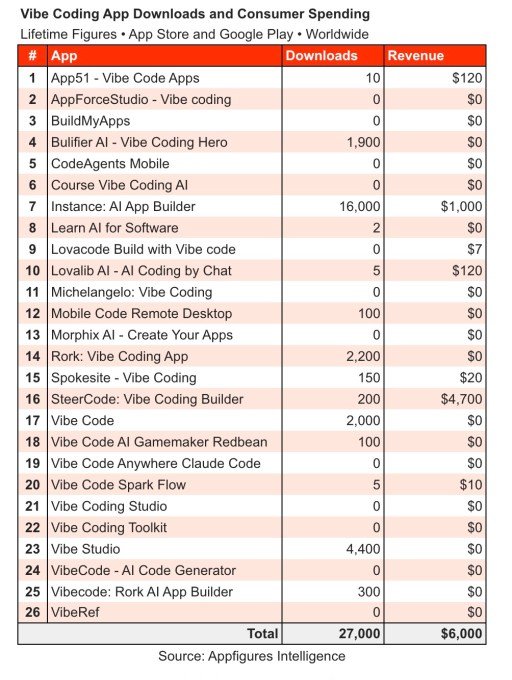
Recent data from app intelligence provider Appfigures reveals a stark landscape for developers in this niche. Most mobile vibe-coding applications have seen negligible download numbers, with even fewer managing to monetize their services.
Current market leaders highlight the struggle for scale:
- Instance: AI App Builder: Leads the category with approximately 16,000 downloads and a modest $1,000 in consumer spending.
- Vibe Studio: Follows with roughly 4,000 downloads, yet has failed to generate any revenue to date.
Is There Room for Growth?
Despite the current stagnation, the market remains in its infancy. New entrants continue to emerge, such as Vibecode, which recently secured $9.4 million in seed funding from Alexis Ohanian’s Seven Seven Six. As these platforms iterate and resolve technical bugs, the mobile experience may eventually improve.
The Desktop Dominance and Backend Integration
For now, serious development work remains anchored to desktop environments. However, vibe coding is quietly making an impact on the mobile ecosystem from the backend. Subscription platform RevenueCat reports that it now powers in-app purchases for over 50% of all AI-built iOS applications.
Notably, the influence of AI assistants in driving monetization services is surging. RevenueCat observed that referrals from AI chatbots to its monetization platform grew from under 5% in Q2 2024 to over 35% in Q2 2025. Developers are leveraging the RevenueCat MCP server to integrate AI tools like Cursor and Claude Code, streamlining subscription and feature testing.
Market Sentiment: High Interest, Low Readiness
The gap between interest and utility remains wide. A Fastly survey indicates that 95% of nearly 800 developers still find themselves correcting AI-generated code, suggesting the technology is not yet ready for prime time.
Nevertheless, the demand for integration is undeniable:
- Stack Overflow (2025): 84% of respondents are using or planning to use AI in their development workflow.
- The Information: 75% of surveyed users have experimented with vibe coding.
- Jellyfish (May 2025): 90% of software organizations have integrated AI, a significant jump from 61% the previous year, as noted by Business Insider.