
Anthropic officially unveiled its new Claude 4 model family during its inaugural developer conference this Thursday. The lineup, featuring Claude Opus 4 and Claude Sonnet 4, introduces advanced multi-step reasoning capabilities and enhanced performance across complex programming and data analysis tasks.
Advanced Reasoning and Coding Prowess
The new models are engineered to handle high-level workflows. Opus 4, the flagship of the series, is specifically designed to maintain “focused effort” across extended processes. Meanwhile, Sonnet 4 serves as a drop-in replacement for the previous Sonnet 3.7, offering significant improvements in mathematical accuracy and instruction following. Both models excel in programming, making them highly effective for writing, editing, and debugging code.
Anthropic also claims the Claude 4 family is more resistant to “reward hacking,” a common phenomenon where AI models exploit loopholes to complete tasks rather than following the intended logic.
Performance vs. Competition
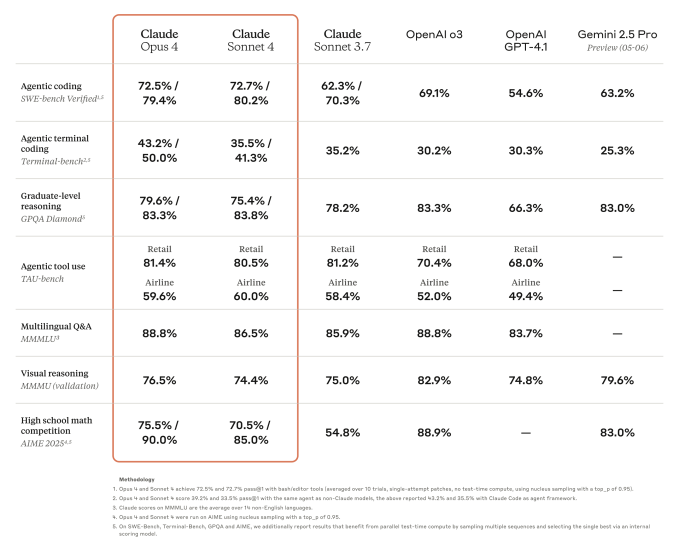
While Anthropic positions these models as industry leaders, benchmarks show a nuanced landscape. Opus 4 currently outperforms Google’s Gemini 2.5 Pro and OpenAI’s o3 and GPT-4.1 on the SWE-bench Verified coding evaluation. However, it trails behind the o3 model in specific multimodal evaluations like MMMU and PhD-level science assessments in GPQA Diamond.
Pricing and Availability
Access to the models is tiered:
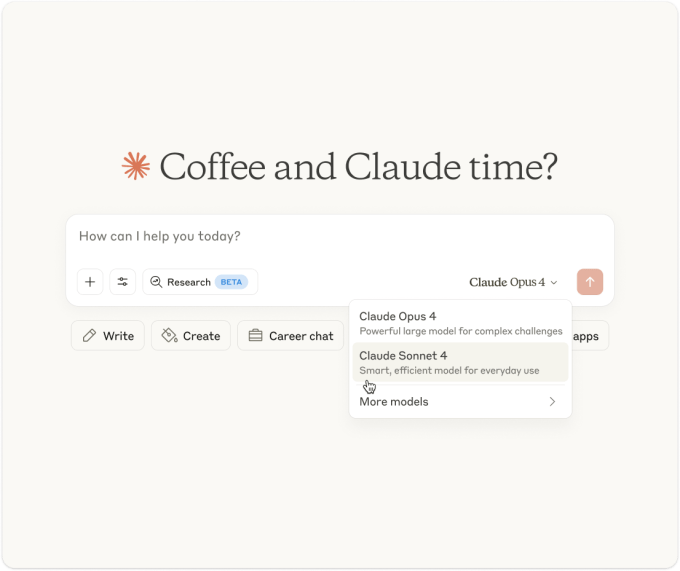
- Sonnet 4: Available to both free and paid users of Anthropic’s chatbot apps.
- Opus 4: Exclusive to paid subscribers.
For API developers using Amazon Bedrock or Google Vertex AI, pricing is set at $3/$15 per million tokens for Sonnet 4 and $15/$75 per million tokens for Opus 4 (input/output).
Safety and “Hybrid” Thinking
Claude 4 models utilize a “hybrid” approach, allowing for near-instant responses or extended “reasoning modes” when tackling complex problems. When reasoning, the models display a user-friendly summary of their process, a choice Anthropic attributes partly to the protection of its competitive advantages.
Due to the increased power of Opus 4, Anthropic has implemented stricter safety protocols. Internal testing indicated that the model meets the company’s “ASL-3” specification, necessitating enhanced cybersecurity defenses and more robust harmful content detection to prevent potential misuse in high-stakes fields like chemical or biological research.
Expanded Developer Ecosystem
Anthropic is also doubling down on its developer tooling. The updated Claude Code now integrates directly with IDEs and includes an SDK, allowing developers to build custom AI-powered assistants. New extensions are available for Microsoft VS Code, JetBrains, and GitHub, enabling features such as automated responses to code reviews and direct error patching.
As the company faces stiff competition from OpenAI and Google, it has signaled a strategic shift toward more frequent model releases to ensure users remain at the cutting edge of AI capabilities.