
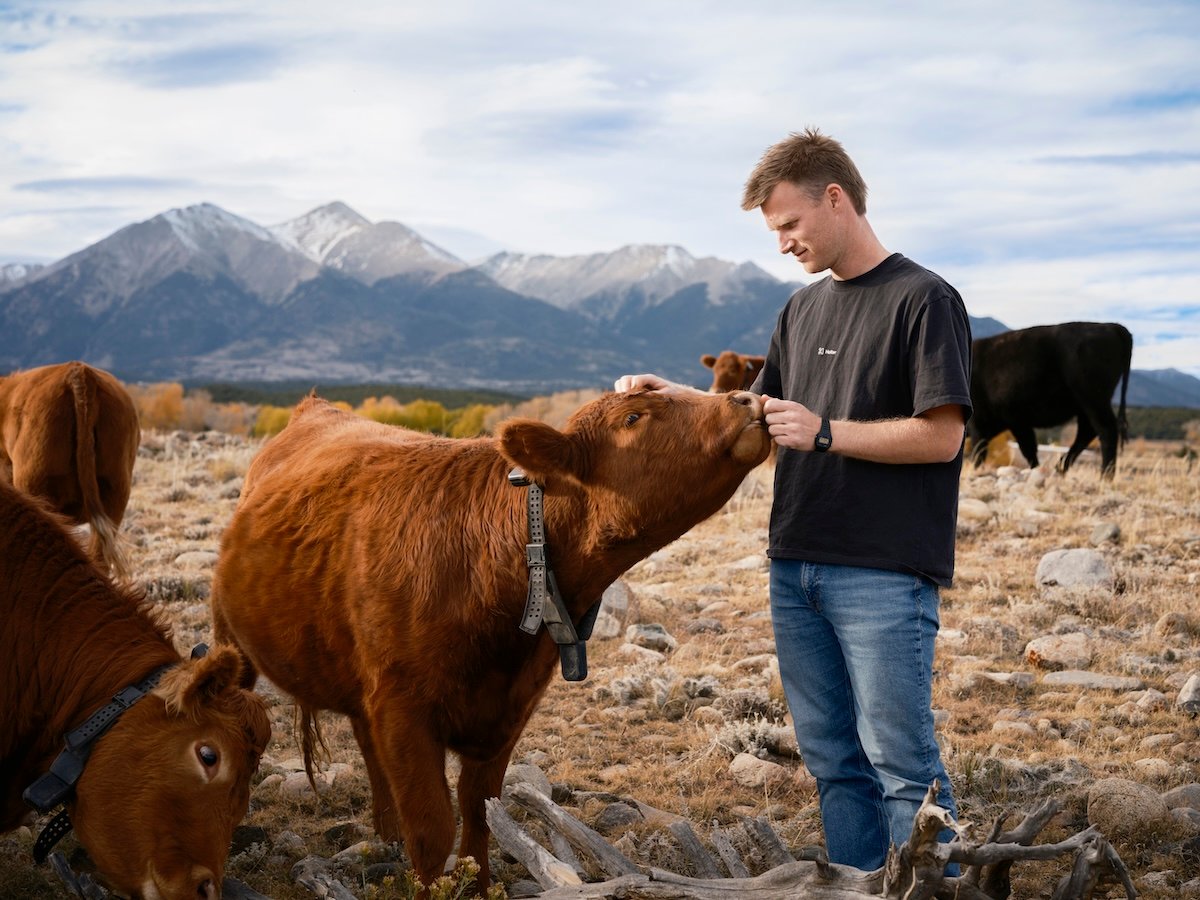
Founders Fund, the venture capital firm led by Peter Thiel, has spearheaded a massive $220 million Series E funding round for Halter, a New Zealand-based startup revolutionizing livestock management. The company, which is now valued at $2 billion, provides solar-powered smart collars that enable farmers to manage cattle herds virtually, eliminating the need for traditional labor-intensive methods like dogs, horses, or helicopters.
The Future of Virtual Fencing
Founded nine years ago by Craig Piggott, Halter solves one of agriculture’s most persistent challenges: managing livestock across vast, remote terrain. The system integrates solar-powered hardware with a network of low-frequency towers and a smartphone application. By utilizing audio and vibration cues—similar to a vehicle’s proximity sensors—the collars guide cattle within virtual boundaries defined by the farmer.
“Fences are the lever that controls grazing and land rest,” Piggott explained. By shifting to a virtual model, farmers can monitor and move herds remotely, significantly optimizing land productivity. Most cattle learn to respond to the system’s cues within just three interactions.
Data-Driven Cattle Health
Beyond herding, the collars function as high-tech health monitors. Because the devices remain active around the clock, they collect extensive behavioral data, tracking fertility cycles and identifying potential illnesses in individual animals. As the company moves into its fifth generation of hardware, these insights have become increasingly precise, leveraging what is likely the world’s largest dataset on cattle behavior.
Scaling the Agricultural Frontier
Currently, Halter’s technology is deployed on over one million cattle across more than 2,000 farms in New Zealand, Australia, and 22 U.S. states. The financial incentive for adoption is clear: Piggott claims that by optimizing grazing patterns, farmers can increase land output by up to 20%, with some cases reporting a total doubling of production.
Overcoming Industry Skepticism
While competitors like Merck’s Vence and drone-based startups like Grazemate are entering the space, Piggott remains focused on the hardware’s reliability. He argues that the primary barrier for the company is not rival technology, but the agricultural industry’s traditional resistance to change. “The biggest competition is just not changing anything,” he noted.
Halter differentiates itself through a relentless focus on return on investment (ROI). In an agricultural tech sector often plagued by high operational costs and low adoption, Halter has secured its position by ensuring the product pays for itself through increased yields.
Global Ambitions
With roughly $400 million raised to date, the company is eyeing aggressive expansion into South America and Europe. Despite the current success, Piggott maintains that the startup is still in its infancy. With over one billion cattle globally and less than 10% market penetration even in their home country of New Zealand, the scale of the opportunity remains immense.