
Meta officially shuttered CrowdTangle this week, ending a vital era for journalists, researchers, and politicians who relied on the tool to monitor disinformation on Facebook and Instagram. The move comes just months before a high-stakes U.S. election, sparking intense backlash from experts who argue the replacement—Meta Content Library (MCL)—is functionally inadequate.
The Access Gap: Who Gets Left Behind?
While Meta is promoting its new Content Library, access is strictly gated. The tool is now restricted to “qualified academic or nonprofit institutions” engaged in scientific or public interest research. This leaves the vast majority of journalists, independent analysts, and civil society watchdogs entirely barred from the platform.
Critics report that MCL is not only less accessible but also suffers from a poor user experience, limited transparency, and a massive reduction in functional capabilities compared to its predecessor.
Feature Deficit: “1% of the Capabilities”
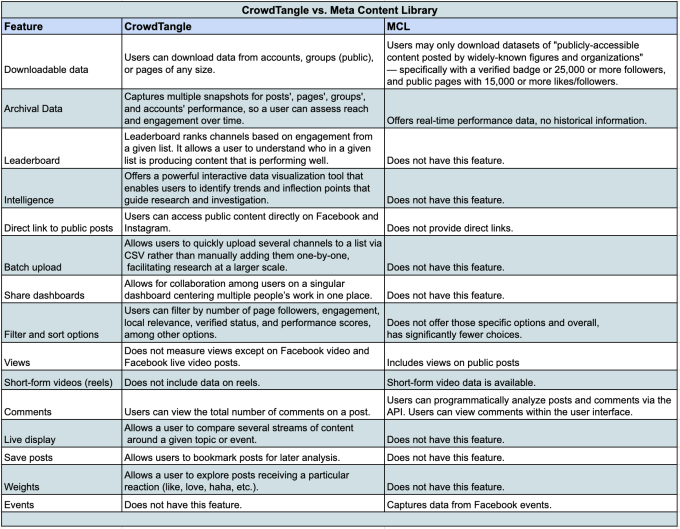
Cameron Hickey, CEO of the National Conference on Citizenship, did not mince words regarding the transition. After co-authoring a report on the shift, Hickey estimated that the Meta Content Library offers only “1% of the features” present in CrowdTangle.
Key limitations cited by researchers include:
- Inability to track historical data: Users can no longer track follower counts over time for specific pages, a metric crucial for understanding the influence of various actors.
- Export Restrictions: Unlike CrowdTangle, MCL prevents the bulk downloading of posts, forcing researchers to resort to risky data-scraping methods.
- Dashboard Limitations: The ability to build interactive, public-facing dashboards has been largely stripped away.
Meta’s Defense vs. Reality
Meta President of Global Affairs Nick Clegg previously dismissed CrowdTangle as a “degrading tool” that only measured a “narrow cake slice” of engagement. Meta maintains that the new Content Library offers a more comprehensive view, including Reels and page-view counts, with plans to integrate Threads data soon.
However, this narrative contradicts Meta’s own strategy from 2020, when the company actively promoted CrowdTangle to election boards and government officials to help them identify voter suppression and misinformation.
The Impact on Election Integrity
The timing of this shutdown is raising red flags. Media Matters, a nonprofit watchdog, confirmed they have been denied access to MCL. In the past, the group used CrowdTangle to debunk claims of anti-conservative bias, showing that right-leaning pages often receive disproportionately higher engagement.
“Algorithms are usually a black box,” said Kayla Gogarty, research director at Media Matters. “Having that engagement data helped us learn a little more about how they function.”
Brandi Geurkink, executive director of the Coalition for Independent Technology Research, warned that the shutdown limits the ability of civil society to monitor the platforms during a critical election year. As the industry grapples with the rise of AI-generated deepfakes and misinformation, the loss of this diagnostic tool creates a dangerous information vacuum.
While Meta claims to have launched a configurable real-time dashboard to mitigate these concerns, critics argue the damage to transparency is already done. Comparisons are now being drawn to Elon Musk’s aggressive restriction of the Twitter API, suggesting a broader trend of tech giants pulling back the curtain on their own data ecosystems.