
Notion has officially resolved one of its most persistent user complaints: the inability to work without an internet connection. The company announced on Tuesday that it has introduced a robust offline mode across its desktop and mobile applications, finally ending the limitations of its cloud-first architecture.
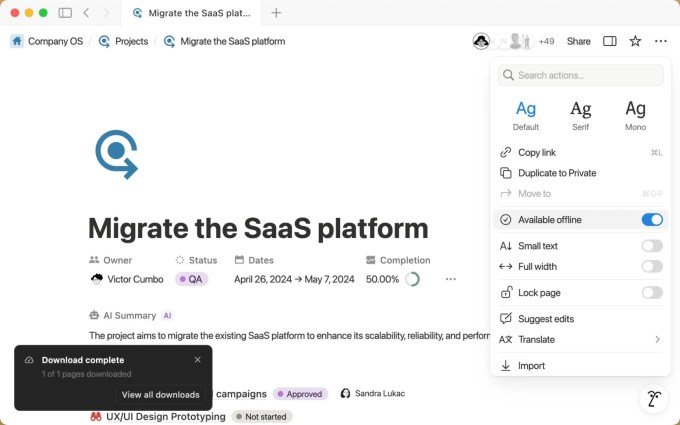
Full Flexibility: View, Edit, and Create Offline
The update allows users to view, edit, and create new notes seamlessly, regardless of their connectivity status. When a device is offline, users can continue their workflow, and the application will automatically synchronize all pending changes once a connection is re-established.
However, the company clarified that certain interactive elements—such as embeds, forms, and buttons—remain dependent on an active internet connection and will not function while offline.
Advanced Syncing and Management
For users on Plus, Business, or Enterprise plans, the application introduces a smart caching feature that automatically downloads recently viewed and favorited pages for immediate access. This ensures that essential documents are always available, even in areas with poor or no connectivity.
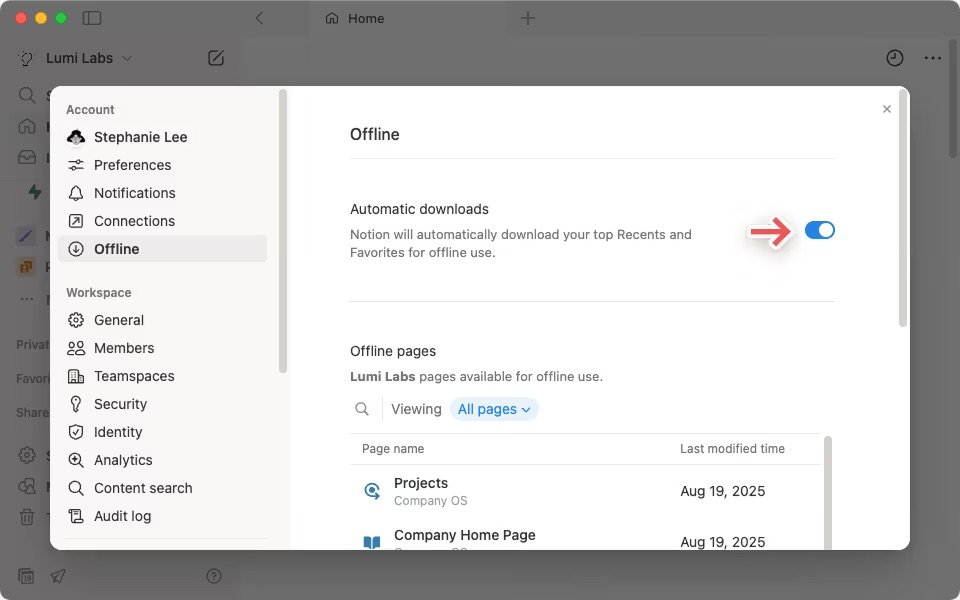
Users maintain full control over their data footprint. Through a new “Offline” menu located within the settings panel, it is possible to toggle automatic downloads off or manually manage which pages are stored locally on the device.
Why Did It Take So Long?
The delay in rolling out this highly requested feature was due to technical complexity. Notion CEO Ivan Zhao explained in a thread on X that the platform’s architecture relies on a sophisticated database system to store various blocks.
To enable offline work, the engineering team had to build a robust conflict-resolution mechanism. This system is critical for managing instances where multiple users might edit the same document simultaneously while disconnected, ensuring that data integrity is preserved once all devices sync back to the cloud.
As the company confirmed in its official announcement, this capability stands as one of the most requested features in the platform’s history, marking a significant milestone in the software’s evolution.