
Spotify confirmed it distributed $10 billion to the music industry in 2024, bringing its total payouts to nearly $60 billion since the platform’s inception. This disclosure arrives as the streaming giant faces ongoing scrutiny regarding how fairly it compensates artists for their creative work.
The Scale of Streaming Payouts
The $10 billion figure encompasses royalties paid not only to artists but also to publishers and other industry partners. According to data from the International Federation of the Phonographic Industry (IFPI), the global streaming landscape now serves over 500 million paying customers. Spotify currently accounts for 252 million of those subscribers, as noted in its Q3 2024 financial filing, with over 60% of its total user base utilizing the ad-supported free tier.
David Kaefer, Spotify’s VP of Music Business, defended these figures, stating that the company’s ecosystem is functioning as intended. “Today, there are more than 500 million paying listeners across all music streaming services. A world with 1 billion paying listeners is a realistic goal we should collectively set,” Kaefer remarked.
Controversy Over Per-Stream Rates
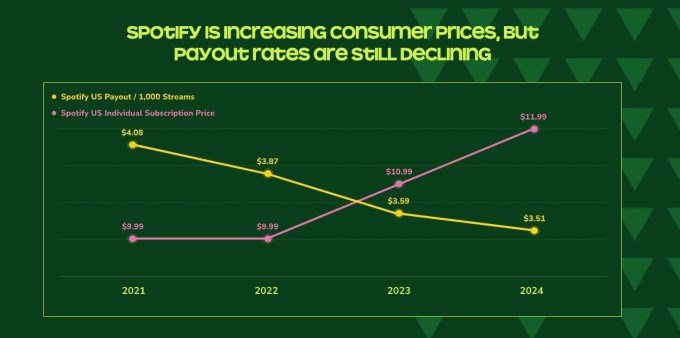
Despite Spotify’s defensive stance, the company faces criticism regarding its payout efficiency. A recent report from music financing platform Duetti suggested that while per-stream rates for independent artists are stabilizing, Spotify ranks at the bottom of the industry. The report claims Spotify pays $3.00 per 1,000 streams, trailing behind competitors like Amazon Music ($8.80), Apple Music ($6.20), and YouTube ($4.80).
Furthermore, analysts point to Spotify’s “Discover Mode”—a feature where artists accept lower royalty rates in exchange for algorithmic promotion—as a factor that forces artists to generate significantly higher stream counts just to maintain stable income levels.
Spotify’s Rebuttal
Spotify has aggressively dismissed the Duetti report, labeling its findings as “ridiculous and unfounded.” A company spokesperson clarified the platform’s economic model:
“No streaming service pays per stream because that approach would incentivize streaming services to minimize streams. It would mean low engagement, fewer artist connections, and lower overall payouts. Instead, we take the opposite approach. We want users to engage more so that they pay more.”
The Growing Competition for Streaming Revenue
The tension over payouts coincides with a massive surge in content volume. According to Luminate’s 2024 year-end report, an average of 99,000 new tracks are uploaded to streaming platforms daily. While global streams reached a record 4.8 trillion—a 14% year-on-year increase—the sheer volume of music makes it increasingly difficult for individual artists to capture a significant share of the pie.
Spotify counters this narrative by highlighting that the number of artists earning over $100,000 annually from the platform has surpassed 10,000, a significant increase from the 10,000 artists who were earning at least $10,000 per year back in 2014.