

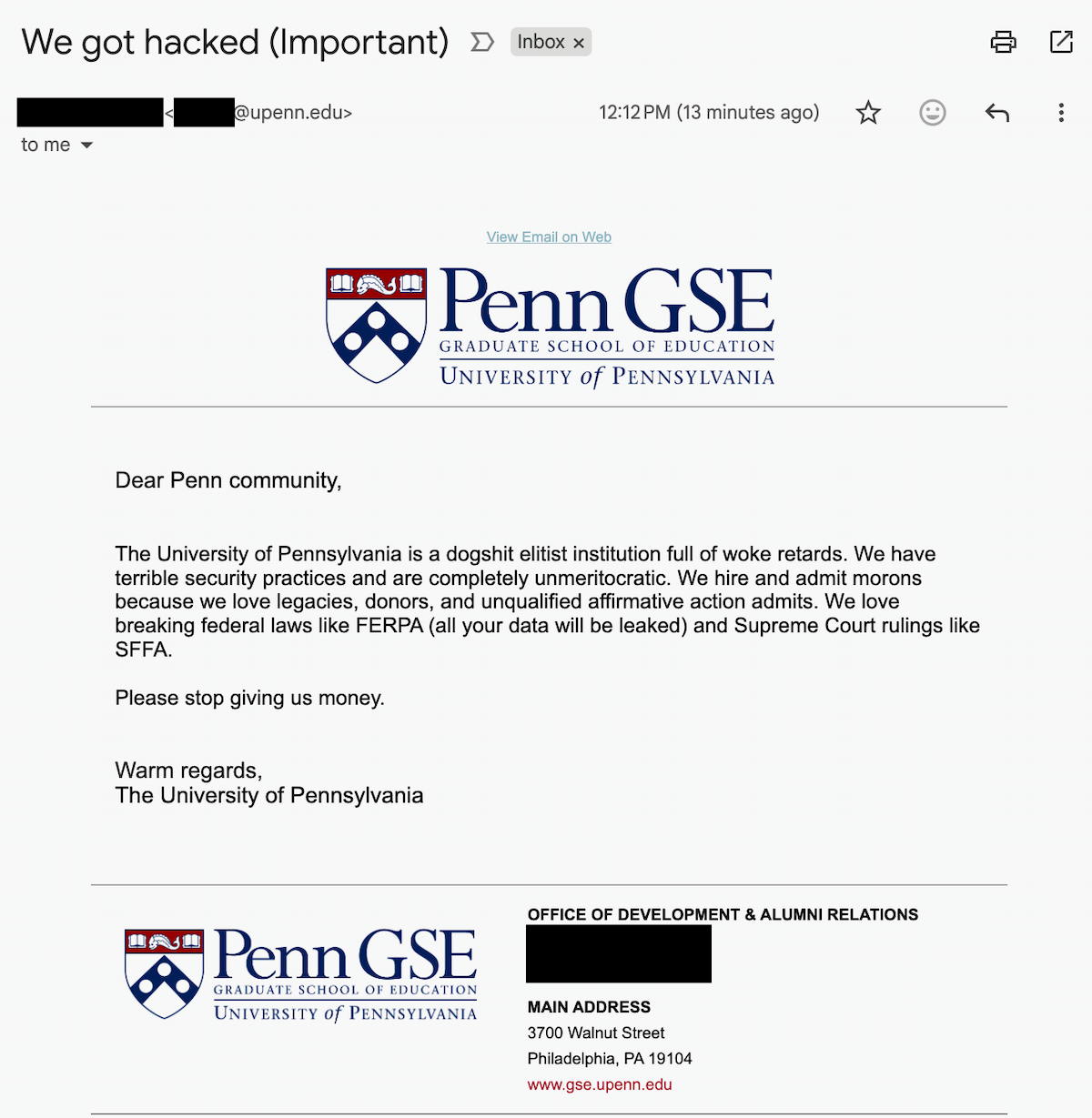
On Friday morning, the University of Pennsylvania (UPenn) became the target of a sophisticated cyberattack. Hackers compromised the university’s internal systems to distribute mass emails to students, staff, and alumni, masquerading as the Graduate School of Education (GSE) and senior faculty members.
The malicious messages contained inflammatory claims, alleging that the university maintains poor security standards and violates federal regulations, including the Family Educational Rights and Privacy Act (FERPA). The intruders explicitly threatened to leak sensitive institutional data.
Institutional Response and Security Status
UPenn spokesperson Ron Ozio confirmed that the university’s incident response team is “actively addressing” the breach. In an official statement, Ozio categorized the correspondence as fraudulent, noting that the offensive content within the emails does not align with the values or operational mission of the university or the GSE.
The breach appears to be widespread, as many affiliates reported receiving multiple versions of the fraudulent emails from various official @upenn.edu addresses. Security teams are currently working to contain the unauthorized access and mitigate further risks to the university’s communication infrastructure.
Motivations Behind the Attack
Beyond the threats of data exposure, the hackers explicitly urged recipients to cease financial contributions to the institution. This suggests a targeted effort to disrupt alumni donations. The timing of the incident follows the university’s public rejection of the White House’s “Compact for Academic Excellence in Higher Education.”
UPenn, alongside six other major universities, declined to sign the proposal, which outlines strict mandates for federal funding eligibility. These conditions include:
- Abolishing affirmative action in admissions and hiring.
- Freezing tuition rates for a five-year period.
- Capping international undergraduate enrollment at 15%.
- Mandating the use of standardized testing for admissions.
- Implementing policies that critics argue marginalize transgender and gender non-conforming students.
The Academic Freedom Debate
In his official response to Secretary of Education Linda McMahon, UPenn President J. Larry Jameson addressed the ideological constraints of the compact. He stated that the proposal favors specific political viewpoints while infringing upon the viewpoint diversity essential to academic institutions.
Jameson emphasized that such “one-sided conditions” conflict with the fundamental principles of freedom of expression, which remain central to the university’s role in democratic society.