

Zoom has officially launched its AI Companion 3.0, introducing a robust web-based interface that extends powerful artificial intelligence capabilities to all users, including those on free plans. This update marks a significant shift in the company’s strategy, aiming to democratize meeting intelligence and productivity tools.
New Features for Free Users
Free plan users now gain access to core AI features, albeit with specific usage caps. This includes the ability to generate meeting summaries, identify action items, and extract key insights. Specifically, free-tier subscribers can utilize the AI Companion within three meetings per month. Each session includes comprehensive summaries, in-meeting questioning, and automated note-taking. Additionally, users can pose up to 20 questions via the side panel and the new web interface. For those requiring higher volume, a $10 add-on plan is available to unlock expanded features.
Advanced Integration and Data Retrieval
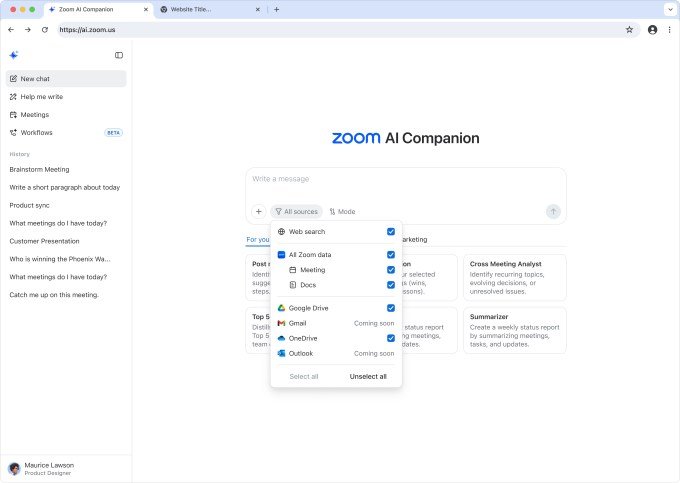
The AI Companion’s utility is significantly bolstered by its ability to pull data from external ecosystems. Currently, the assistant can retrieve information from Google Drive and Microsoft OneDrive, centralizing data alongside existing Zoom assets. The company has confirmed that direct support for Gmail and Microsoft Outlook will be added shortly, further streamlining the workflow for enterprise and individual users.
Enhanced Productivity and Document Management
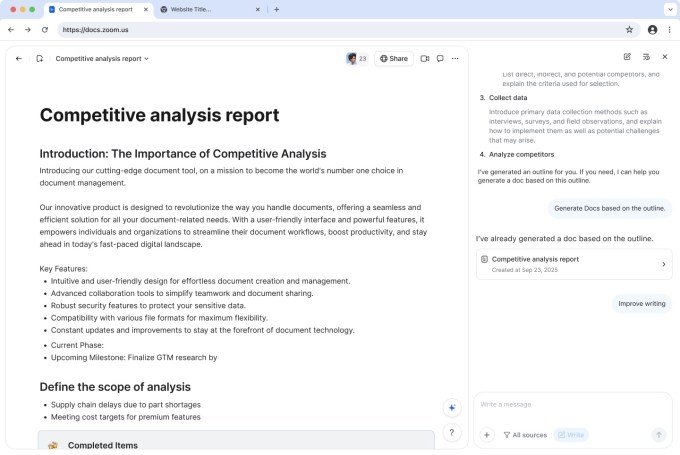
Beyond summaries, the update introduces sophisticated document management tools. Users can now draft and edit content directly based on meeting details. The platform allows for seamless transitions from the companion interface into Zoom Docs, facilitating real-time collaboration. Completed files can be exported in various formats, including MD, PDF, Microsoft Word, and native Zoom Docs, providing flexibility for diverse professional environments.
Daily Reflections and Strategic Positioning
The AI Companion also features a “daily reflection” report, which synthesizes meetings, pending tasks, and updates into a single overview. The assistant is further capable of generating follow-up assignments and drafting email responses.
Lijuan Qin, head of AI product at Zoom, emphasizes that the company’s status as an independent operator provides a unique advantage. By leveraging proprietary models in combination with technology from industry leaders like OpenAI and Anthropic, Zoom maintains a deep contextual understanding of meeting data. This positioning is critical as Zoom evolves from a simple video conferencing tool into a comprehensive productivity suite, competing directly with major players like Google, Microsoft, ClickUp, and Notion for dominance in the enterprise software market.