
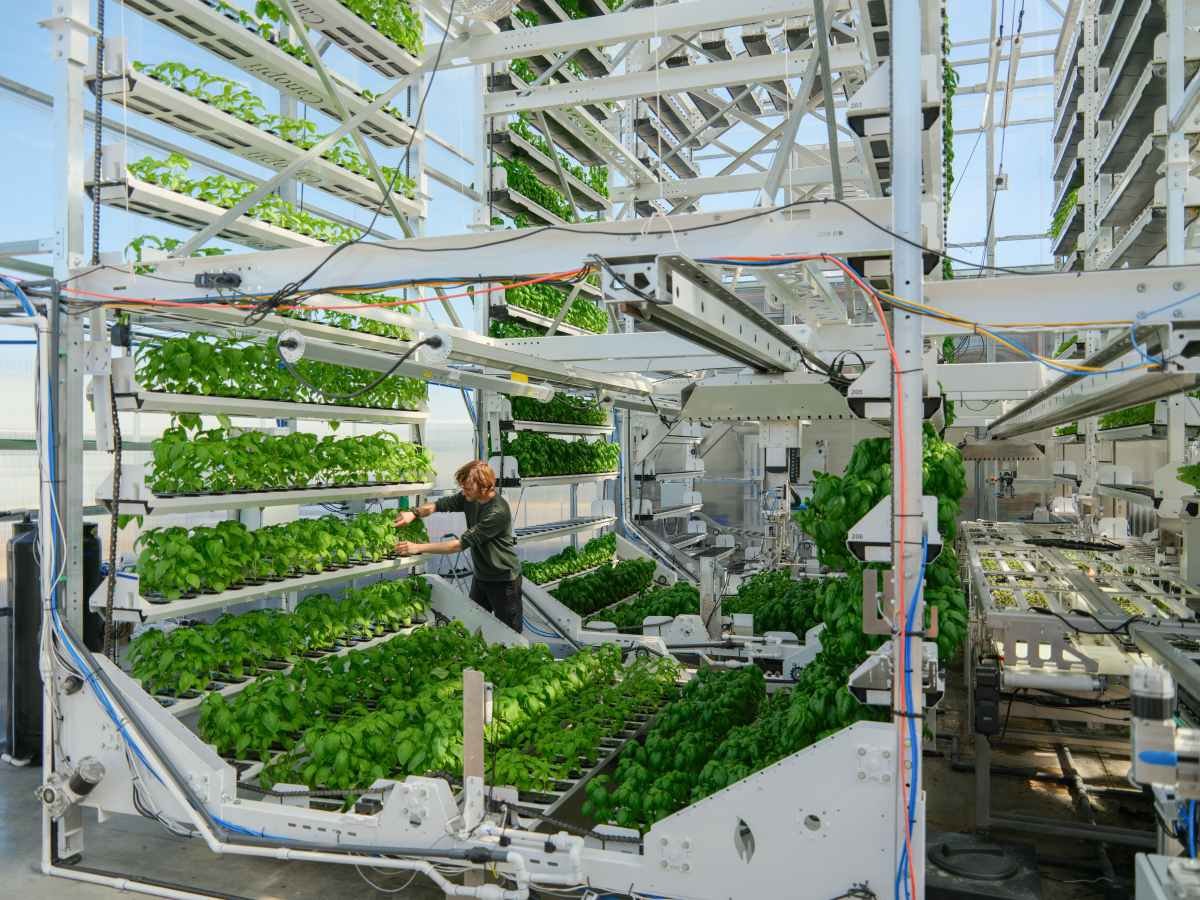
David Ashton, founder of the agtech startup Canopii, is challenging the turbulent indoor farming industry with a lean, autonomous model. Based in Portland, Oregon, the company has successfully developed robotic greenhouses capable of managing the entire cultivation cycle—from seeding to harvest—entirely without human intervention.
Efficiency in a Limited Footprint
Canopii’s innovative approach addresses the critical issue of water scarcity and supply chain inefficiency. Their greenhouses occupy the space of a single basketball court yet can yield up to 40,000 pounds of produce annually. The system is designed for extreme resource efficiency, requiring only a single water connection and operating on standard household power—100 AMPs and 240 volts.
Currently, the company utilizes these facilities, manufactured by GK Designs, to cultivate specialty greens and herbs, including baby bok choy and gai lan.
A Different Path to Growth
Unlike many industry predecessors that burned through massive amounts of venture capital only to face bankruptcy, Canopii has taken a deliberate, slow-growth trajectory. Since its inception five years ago, the company has raised approximately $3.6 million, with $2.3 million secured through National Science Foundation grants. This non-dilutive funding allowed the team to iterate on a single farm prototype before considering rapid expansion.
Learning from Industry Failures
Ashton is acutely aware of the skepticism surrounding the indoor farming sector, which saw giants like Bowery Farming and Plenty struggle after massive capital injections. He attributes Canopii’s resilience to avoiding the “VC-first” mentality that often forces premature scaling in complex food infrastructure projects.
“The capital stack has to be diversified beyond VC,” Ashton stated. “If we tried to scale after year one or two, that simply isn’t possible with food infrastructure.”
Scaling the Vision
With the automation milestone achieved, Canopii is shifting its focus toward building its first commercial farm in downtown Portland. The company has already seen inbound interest from a diverse range of clients, including schools, restaurants, and casinos.
Looking ahead, the company plans to utilize a franchise model to scale its technology. By treating the greenhouses as mass-produced units—similar to vehicles—Ashton believes they can decentralize food production, bringing farms into backyards and urban centers without the resource-heavy overhead that plagued previous industry attempts.