

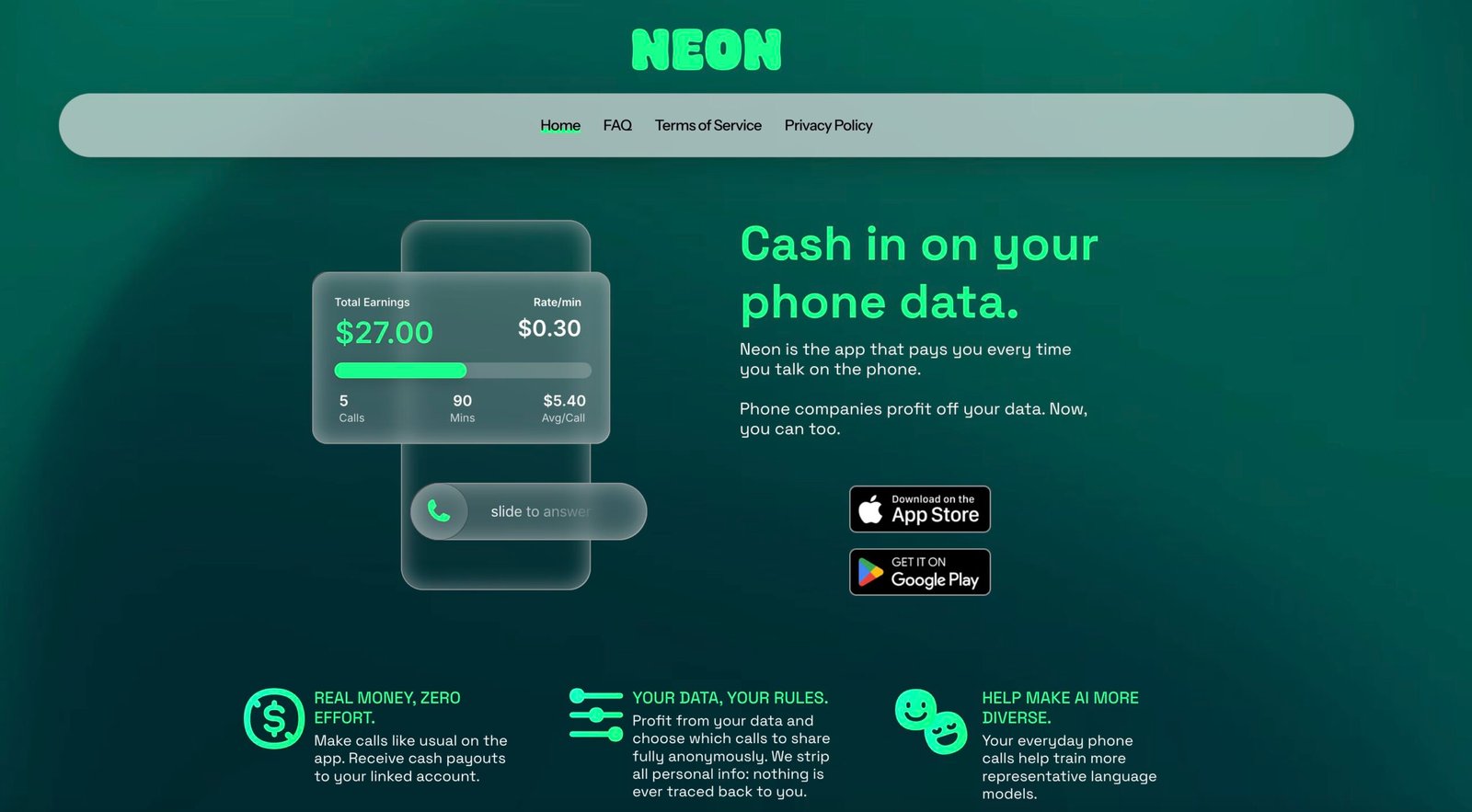
Neon Mobile, a controversial new application that pays users to record their phone calls and sells the audio data to artificial intelligence firms, has surged to the No. 2 spot in the Social Networking category of the Apple App Store. The app, which incentivizes users with payouts of “hundreds or even thousands of dollars per year,” is rapidly gaining traction despite significant privacy and legal red flags.
The Business Model: Monetizing Private Conversations
According to the company’s official website, Neon Mobile offers 30 cents per minute for calls made to other app users and up to $30 per day for calls placed to external contacts. Data from Appfigures indicates an explosive growth trajectory: the app jumped from ranking 476th in the Social Networking category on September 18 to reaching the top 10 within just days.
The core of the service involves capturing inbound and outbound calls. While marketing materials suggest the app only records the user’s side of the conversation—unless both parties are using the app—the company’s terms of service grant them a sweeping, irrevocable license to “sell, use, host, store, and distribute” these recordings to AI companies for training machine learning models.
Legal and Security Risks
Legal experts suggest the app may be operating in a gray area to circumvent strict wiretap laws. By focusing on recording “one side” of a conversation, Neon Mobile attempts to mitigate the legal requirement for dual-party consent prevalent in many states. However, attorneys warn that this could be a technical loophole, as the app might still capture the full audio stream.

Beyond the legal structure, security professionals are sounding the alarm on the potential for identity fraud. Even if Neon anonymizes the data, the sale of high-fidelity voice recordings to third-party AI partners poses a severe risk. “Once your voice is over there, it can be used for fraud,” explains Peter Jackson, a privacy attorney at Greenberg Glusker. He notes that bad actors could use these samples to create AI-generated voice clones for impersonation attacks.
The Desensitization to Privacy
The app’s popularity reflects a growing trend where users are increasingly willing to trade personal privacy for minor financial incentives. Unlike previous scandals involving surreptitious data collection, Neon Mobile is transparent about its intent, yet users appear indifferent to the long-term consequences of surrendering their biometric data.
Jennifer Daniels, a partner at Blank Rome, emphasizes that the issue extends beyond the individual user. By using such tools, individuals are not only compromising their own data but are also inadvertently exposing the privacy of everyone they contact. As AI continues to integrate into daily communication, the barrier between professional productivity and personal data security continues to erode, leaving callers vulnerable to entities whose long-term data handling policies remain opaque.