
Meta’s Llama stands as a flagship generative AI model, distinguishing itself from competitors like OpenAI’s ChatGPT, Google’s Gemini, and Anthropic’s Claude through its “open” architecture. Unlike closed-source models restricted to API access, Llama allows developers to download, customize, and deploy models according to their specific requirements.
What is Llama?
Llama is not a single model but an evolving family of AI architectures. The latest iteration, Llama 4, was released in April 2025 and features three distinct models:
- Scout: Features 17 billion active parameters, 109 billion total parameters, and a massive 10 million token context window.
- Maverick: Equipped with 17 billion active parameters, 400 billion total parameters, and a 1 million token context window.
- Behemoth: Currently in training, this powerhouse will feature 288 billion active parameters and 2 trillion total parameters.
Meta’s latest models utilize a “mixture-of-experts” (MoE) architecture, which optimizes efficiency by reducing computational load during training and inference. Llama 4 Scout and Maverick are notable for being Meta’s first open-weight natively multimodal models, trained on vast datasets of text, images, and video across 200 languages.
Key Capabilities and Use Cases
Llama is designed to handle complex tasks, including coding, mathematical problem-solving, and document summarization. While Scout is optimized for massive data analysis and long-form workflows, Maverick serves as a balanced generalist for chatbots and technical assistants. Behemoth is intended for high-level research and STEM-focused tasks.
Developers can integrate Llama with third-party tools to enhance functionality, such as using Brave Search for real-time data, Wolfram Alpha for scientific queries, or Python interpreters for code validation.
Where to Access Llama
Consumers can interact with Llama via the Meta AI chatbot on platforms including WhatsApp, Messenger, Instagram, and Meta.ai. For developers, the models are available via Llama.com and through cloud partners such as AWS, Google Cloud, Microsoft Azure, Nvidia, Databricks, and Hugging Face.
Note that Meta imposes specific licensing constraints: developers with over 700 million monthly active users must request a special, discretionary license from the company.
Safety and Moderation Tools
To mitigate risks, Meta provides a suite of safety frameworks:
- Llama Guard: A moderation tool for detecting problematic content.
- Prompt Guard: Defends against prompt-injection attacks.
- CyberSecEval: A benchmark suite for assessing cybersecurity risks.
- Llama Firewall: Prevents risky tool interactions and malicious inputs.
- Code Shield: Filters insecure code suggestions in real-time.
Risks and Limitations
Despite its capabilities, Llama has well-documented limitations. The model has faced scrutiny for training on copyrighted materials, though courts have currently ruled this falls under “fair use.” Furthermore, Llama can produce “hallucinations”—plausible-sounding but factually incorrect information.
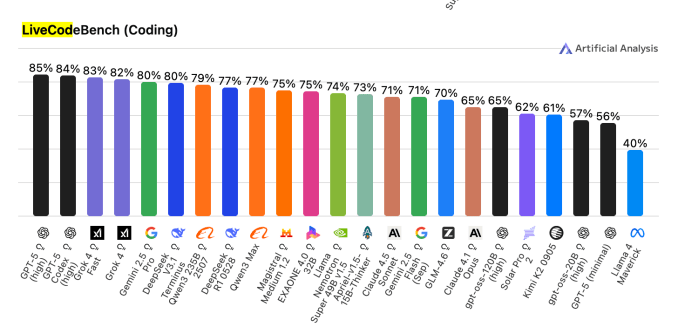
Coding accuracy remains a concern. On LiveCodeBench, the Llama 4 Maverick model scored 40%, trailing behind competitors like OpenAI’s GPT-5 (85%) and xAI’s Grok 4 Fast (83%). Users are strongly advised to subject any AI-generated code to rigorous human review before implementation.